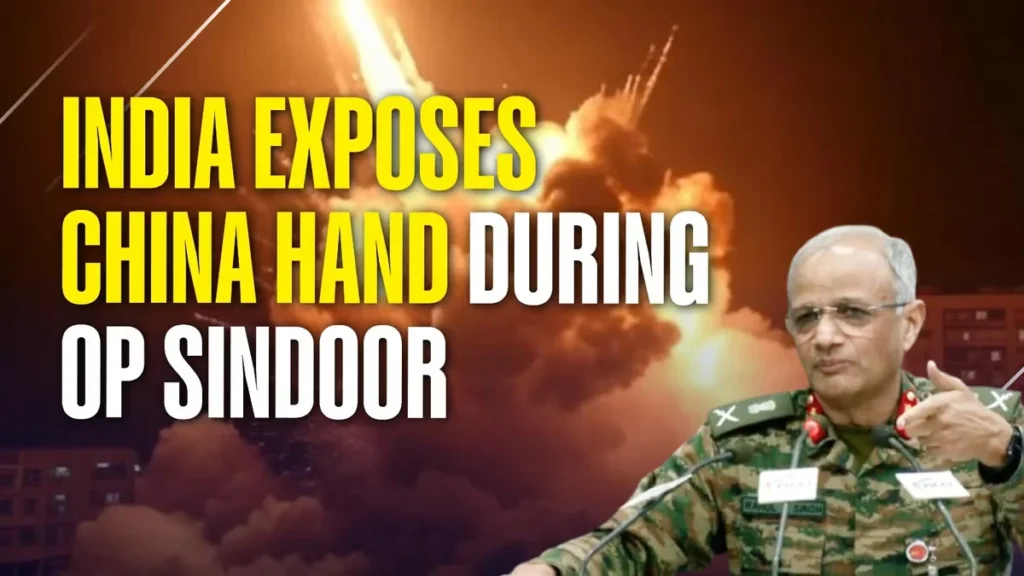
The Indian Army’s Deputy Chief of Staff recently disclosed that Operation Sindoor adversaries extended well beyond Pakistan. Conducted in May 2025 in response to the Pahalgam terrorist attack, the mission saw India targeting terrorist infrastructure. Yet the operation also exposed the complex reality of modern warfare, involving three adversaries: Pakistan, China, and Turkey—all playing different roles in the escalation.
Operation Sindoor: Origins and Objective
Launched on May 7, Operation Sindoor was India’s targeted retaliation following a terror strike in Pahalgam that resulted in the tragic deaths of 26 civilians. The mission involved precision missile and airstrikes on nine terror camps across Pakistan and Pakistan‑occupied Kashmir over 23 minutes. The stated goal was to neutralize terror assets under the doctrine of “terror cannot go unchecked”—carefully avoiding civilian or military infrastructure .
Pakistan: The Frontline Adversary
The Deputy Chief emphasized that Pakistan was the immediate target—“front face” of the operation. Pakistan responded aggressively with drones, missiles, mortars, and troop deployments along the Line of Control. These counter-strikes included drone and missile incursions into Indian airspace—demonstrating Islamabad’s rapid military reaction.
China: The Hidden Support
Bringing Operation Sindoor adversaries into sharper focus, Indian generals confirmed China acted as a silent partner, providing live operational intelligence to Pakistan during the crisis. Lt Gen R.R. Singh described how Beijing shared real-time data on Indian troop positions during DGMO-level negotiations, effectively turning a single-front strike into a multi-faceted confrontation.
Analysts note over 80% of Pakistan’s military hardware is Chinese-made, and Beijing’s data-sharing helped test its systems against India’s increasing defence capabilities.
Turkey: Drone Supply Lines
The Army Deputy Chief also confirmed Turkey’s role in supplying Bayraktar-style armed drones that Pakistan deployed during the hostilities. These drones formed part of a wider military ecosystem alongside Chinese missiles, signalling Islamabad’s strategy of sourcing advanced unmanned systems from foreign suppliers.
Technological Supremacy: India’s Indigenous Edge
Despite the international backup for Pakistan, India achieved decisive success with its own “Made-in-India” defence technology. Systems like BrahMos missiles, Akash SAMs, D4 counter-UAV grids, and S-400 air defences outperformed rival platforms . These platforms not only intercepted incoming threats but also supported precise offensive strikes, reinforcing the Operation Sindoor adversaries narrative.
Civil-Military Briefings and Global Messaging
Post-operation, India briefed diplomatic and military attaches from over 70 countries on the operation’s success—a move signaling accountability and strategic confidence. It also highlighted the involvement of China and Turkey, shaping an informed global understanding of the conflict.
Lessons Learned
Lt Gen Singh noted that “one border, three adversaries” should serve as a lesson. India must enhance its air and missile defence, particularly to protect civilian areas that weren’t fully covered during Sindoor. He called for scaling up surveillance, UAV systems, and integrating diverse defense layers to counter multifront warfare.
Pakistan’s Response & Procurement Strategy
Reports indicate Pakistan has initiated a fresh wave of arms procurement from China and Turkey—especially drones and launcher systems—post-Sindoor. This arms buildup reflects responses to the operational lessons India imparted through its successful strikes.
Strategic Implications for India
- Self-reliance validated: India’s homeland systems proved their efficacy—critical validation of the Atmanirbhar Bharat defence doctrine .
- Two-front threat: With China’s logistical and intelligence support, threats could evolve into a broader strategy—requiring India to fortify along its northern and western frontiers.
- Aerial dominance matters: With drones and missile systems becoming key tools of modern conflict, air defence needs urgent strengthening.
Political & Military Discourse
The national and political narrative around Operation Sindoor underscores India’s resolve to act against terrorism and defend its sovereignty. Military leadership highlighted delayed or muted responses in past conflicts as lessons—this time, action was decisive and decisive.
Future Preparedness
- Expansion of air defence networks to protect cities.
- Faster UAV and counter-UAV deployment across sensitive zones.
- Deeper integration among armed forces and intelligence agencies.
- Heightened readiness against drone and missile threats—key to facing multiple adversaries.
Regional Diplomatic Dynamics
India’s explicit linking of operational challenges to China and Turkey may reshape regional diplomacy. India may pursue strategic dialogues to prevent future military-technology transfers, balancing its global partnerships.
Public Sentiment & Media Response
Media coverage across India widely applauded the military’s success and narrative of confronting adversarial alliances. Meanwhile, Pakistan’s media emphasized perceived Indian aggression, emphasizing escalating mistrust.
Get the latest updated news at RealtimeVoice – your trusted source for real-time headlines and in-depth analysis.
Conclusion
Operation Sindoor was more than an airstrike—it was a demonstration of Operation Sindoor adversaries across multiple dimensions. When the Indian Army engaged Pakistan, it also engaged China’s tech support and Turkey’s drone systems. These tri-pronged challenges—and India’s ability to counter them—underscore the changing face of regional conflict. As the defense doctrine evolves, so too does the urgency to build multi-layered defence preparedness for simultaneous, multi-front threats.