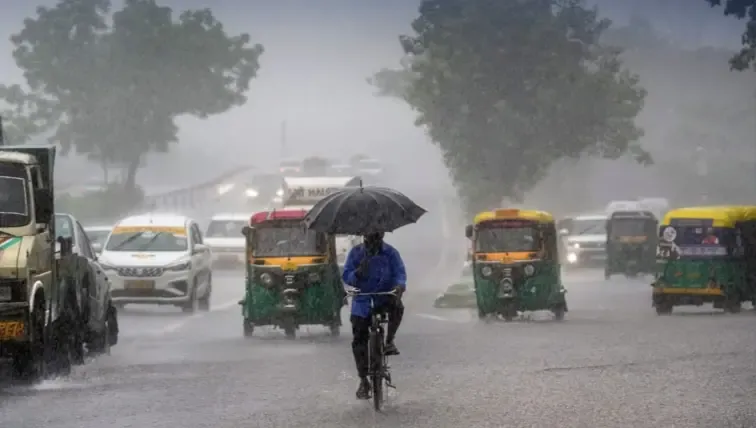

The Indian Meteorological Department (IMD) has issued a promising update for July 2025: above-average monsoon rainfall is expected across large parts of India. According to the July monsoon forecast India, the rain-bearing systems are strengthening, bringing relief after a delayed and scattered onset in June.
This forecast bodes well for agriculture, reservoir levels, and rural consumption, all of which are heavily dependent on the South-West monsoon. The announcement is also expected to lift market sentiment, particularly in the agrarian economy and rural FMCG sectors.
IMD’s Official Forecast Highlights
- Rainfall in July is expected to be 106% of the Long Period Average (LPA).
- Major rainfall likely over: Central India, East India, and Western Himalayan region.
- Southern states may experience slightly below normal rains but still within acceptable range.
- Northeast India expected to maintain near-normal rainfall distribution.
The July monsoon forecast India has improved significantly compared to earlier predictions in June, which showed a dry spell and weak monsoon systems.
Why the July Monsoon Matters
July is the most crucial monsoon month for India, contributing nearly 35% of the total seasonal rainfall. It’s also the period when farmers begin sowing kharif crops like rice, maize, soybean, cotton, and pulses.
A robust July rainfall:
- Ensures optimal soil moisture
- Boosts agricultural productivity
- Enhances reservoir levels for drinking water and power generation
- Promotes rural spending and income stability
Given the country’s dependence on agriculture for both employment and food security, the IMD’s upbeat July monsoon forecast India comes as a vital piece of good news.
Rainfall Distribution Overview
States likely to receive above-normal rainfall:
- Madhya Pradesh
- Chhattisgarh
- Odisha
- Jharkhand
- Uttar Pradesh (eastern region)
- Bihar
- Himachal Pradesh and Uttarakhand
Normal rainfall expected in:
- Gujarat, Maharashtra, Punjab, Haryana, and most of North India.
Slightly below-normal forecast:
- Kerala, Tamil Nadu, Andhra Pradesh, and parts of Telangana.
Agricultural Implications
Farmers who delayed sowing in June due to uneven rains can now catch up. The improved July monsoon forecast India will help:
- Increase acreage of kharif crops
- Boost seed germination and root development
- Reduce dependence on groundwater for irrigation
- Lower the cost of cultivation (diesel and electricity for pumps)
The Agriculture Ministry estimates that nearly 82% of kharif sowing will be completed if the rainfall trend continues as predicted.
Reservoir & Hydropower Impact
The Central Water Commission (CWC) reports that reservoir levels are currently at 78% of last year’s level and 63% of the 10-year average. IMD’s rainfall forecast is expected to:
- Help reservoirs reach full storage capacity by mid-August
- Support uninterrupted hydropower generation
- Provide reliable drinking water supply to rural and urban centers
Economic Boost
The July monsoon forecast India will likely have positive spillover effects on the economy:
- Improved agricultural output boosts rural GDP
- Better rural income increases demand for tractors, two-wheelers, FMCG products
- Reduces food inflation risks
- Strengthens overall consumer sentiment in Tier 2 and Tier 3 markets
Economic analysts project a 0.3–0.5% GDP boost if rainfall continues in the same pattern for August.
Market Reaction
- Equity markets rallied in sectors tied to agriculture—tractor makers, agrochemical firms, and seed companies saw upticks.
- FMCG majors reported early signs of rising rural sales.
- Commodity markets noted price stabilization in pulses and grains futures.
Investors see the July monsoon forecast India as a key short-term trigger for macroeconomic stability and earnings rebound in rural-linked sectors.
Regional Weather Concerns
While the forecast is optimistic, IMD also flagged risks of localized floods due to:
- Excessive rainfall in hill states and northeastern regions
- River overflow in the Ganga and Brahmaputra basins
- Possible landslides in Uttarakhand and Himachal Pradesh
NDMA and state governments have been alerted to ensure swift disaster response mechanisms are in place.
Climate Science & Accuracy
The IMD’s revised forecast used dynamic climate models, including inputs from global agencies such as ECMWF and NOAA. Satellite tracking of the Monsoon Trough, Indian Ocean Dipole (IOD), and Madden-Julian Oscillation (MJO) patterns contributed to refining predictions.
The department has improved its forecasting accuracy to over 80% in the last 5 years, according to independent climate research institutes.
Rural Employment & Policy Outlook
- Rural job demand under MGNREGA is likely to decline as agricultural employment increases
- The Ministry of Rural Development may redirect funds to asset creation and irrigation schemes
- Crop insurance enrollment is expected to rise as farmers capitalize on favorable sowing conditions
The Pradhan Mantri Fasal Bima Yojana (PMFBY) uptake is already up 12% compared to June.
Long-Term View & El Niño Risk
Though the current forecast is positive, climatologists warn of a possible El Niño reactivation in late August. It may:
- Reduce rainfall in southern peninsular India
- Trigger dry spells in September
- Affect the tail end of the monsoon
However, the July monsoon forecast India suggests that even with a weaker finish, the seasonal total may remain above normal, ensuring a strong kharif season.
Political & Public Sentiment
The government has welcomed the forecast, with the Agriculture Minister stating it would “revitalize the rural economy.” Meanwhile, farmers’ groups have demanded:
- Faster subsidy disbursement
- Seed and fertilizer availability in rain-ready districts
- Efficient mandis for post-harvest procurement
Public sentiment remains optimistic, especially in states hit by June’s rain shortfall.
Get the latest updated news at RealtimeVoice – your trusted source for real-time headlines and in-depth analysis.
Conclusion
The July monsoon forecast India paints a hopeful picture for millions of farmers, businesses, and policymakers. If realized, the above-average rainfall will not only support agriculture and water security but also spur economic recovery in rural India. While climate risks remain, the current momentum promises progress and prosperity—one rain at a time.